StreamPark Hosting vs Self-Managed Flink: A Comparison
Compare the costs, complexity, and trade-offs of managed Flink hosting versus running your own Flink infrastructure.
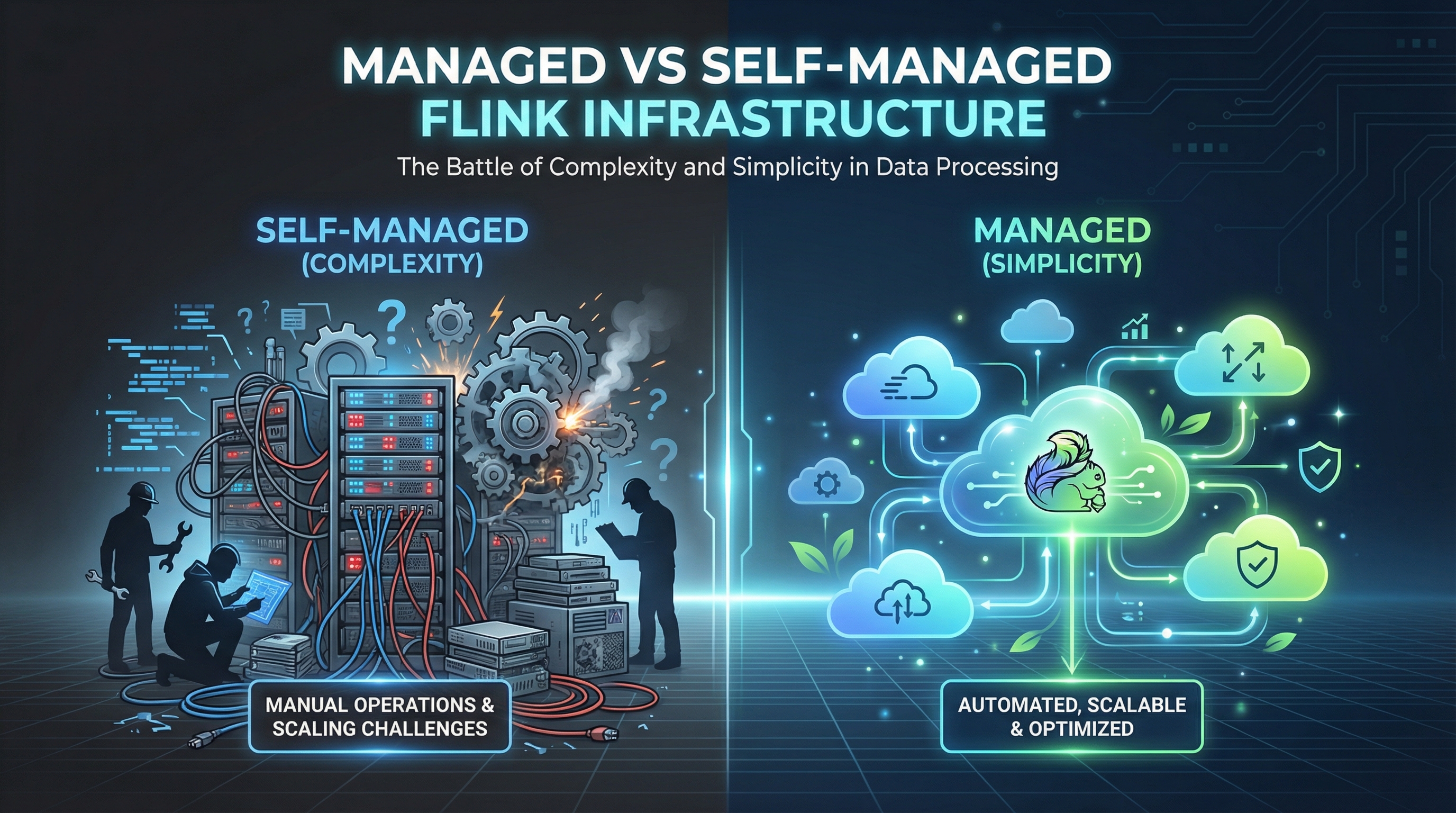
When adopting Apache Flink for stream processing, one of the first decisions you’ll face is: should you run Flink yourself or use a managed service? This guide breaks down the trade-offs to help you make an informed choice.
The Self-Managed Flink Path
Running Flink yourself gives you complete control. You decide the version, configuration, deployment topology, and resource allocation. For some organizations, this control is essential.
What Self-Managed Requires
A production Flink deployment typically includes:
- JobManager(s) — The coordinator that schedules tasks
- TaskManagers — Workers that execute your streaming logic
- ZooKeeper/etcd — For high availability coordination
- State Backend Storage — S3, HDFS, or local disk for checkpoints
- Monitoring Stack — Prometheus, Grafana, or similar
Operational Responsibilities
Beyond initial setup, self-managed Flink requires ongoing work:
| Task | Frequency | Complexity |
|---|---|---|
| Version upgrades | Quarterly | High |
| Security patches | Monthly | Medium |
| Capacity planning | Ongoing | Medium |
| Incident response | As needed | High |
The Managed Flink Path
Managed Flink services like StreamPark Hosting abstract away infrastructure complexity. You interact with a platform that handles deployment, scaling, and operations.
What Managed Provides
Simplified Deployment
Instead of writing Kubernetes manifests and managing clusters, you:
- Upload your JAR or write SQL
- Configure parallelism and resources
- Click deploy
StreamPark handles the rest — provisioning workers, configuring networking, setting up monitoring.
Built-In Best Practices
Managed platforms encode operational knowledge:
- Automatic checkpointing configured with optimal intervals
- State backend pre-configured with cloud storage
- High availability enabled by default
- Security with encryption at rest and in transit
- Monitoring with metrics, logs, and alerting
Cost Comparison
For a team running 10 TaskManagers (4 vCPU each):
| Cost Category | Self-Managed | Managed |
|---|---|---|
| Infrastructure | ~$2,000/mo | Included |
| Platform fees | - | ~$1,500/mo |
| Engineering (40 hrs @ $75/hr) | $3,000/mo | ~$500/mo |
| Total | ~$5,000/mo | ~$2,000/mo |
When to Choose Each
Choose Self-Managed When:
- Regulatory requirements mandate on-premises or specific cloud regions
- Deep customization is needed (custom connectors, patched Flink builds)
- Existing expertise — your team already operates Flink successfully
Choose Managed When:
- Speed matters — you want to deploy quickly without building infrastructure expertise
- Small to medium scale — the operational overhead doesn’t justify dedicated infrastructure engineers
- Core competency — streaming is a tool for your business, not the business itself
StreamPark Hosting: Best of Both Worlds
StreamPark Hosting aims to provide managed simplicity with self-hosted flexibility:
- Apache StreamPark — open-source platform you can run anywhere
- Hosted option — fully managed when you want it
- No lock-in — standard Flink APIs, export jobs anytime
- Visibility — full access to metrics, logs, and Flink UI
Conclusion
Both self-managed and managed Flink have their place. The right choice depends on your team’s expertise, scale, and priorities.
Stream processing is powerful. How you run it should match your team’s strengths.
Considering StreamPark Hosting? Start a free trial or read more about hosted Flink.
StreamPark Team
Building the future of stream processing